

Sensei Jan’s Book
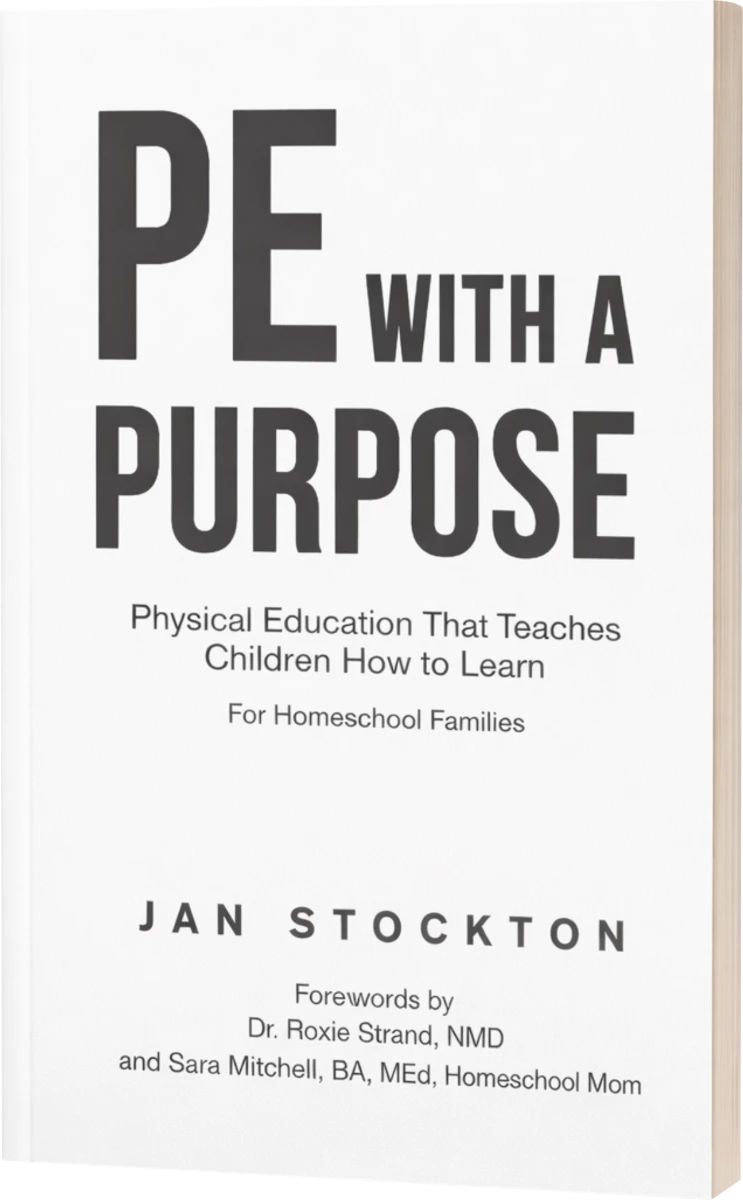
PE With a Purpose
Written for parents, educators, and leaders seeking a more intentional approach to physical education.
For nearly four decades, Jan Stockton has watched children grow more focused, more capable, and more willing to try again when movement is taught with clarity and structure. Confidence does not appear suddenly. It develops gradually through repetition and visible progress. Movement is not a break from learning. It prepares children for it.
PE With a Purpose invites families to see physical education differently — not as activity alone, but as a deliberately designed discipline that strengthens focus, emotional regulation, perseverance, and confidence. These are not soft skills. They are foundational capacities that shape how children learn and grow.
Coming soon to Amazon.
Author’s Note
This work began in quiet moments of observation, watching children train and noticing where they hesitate, how they recover, and how confidence forms through consistent practice. Over time, a pattern became clear. When movement is taught with clear guidance and repetition, students do more than improve physically; they become more capable, more engaged, and more willing to try again.
This work is also personal. As a child, physical education was rarely a place of growth for me. Performance often overshadowed progress, and I felt exposed rather than supported. That experience shaped how I chose to teach and what I chose to build. I became intentional about creating environments where effort matters more than comparison, where structure supports rather than sorts, and where learning develops through steady practice over time.
Although this book was written for homeschool families, the philosophy within it reflects how learning develops in all children, everywhere. What you see at Karate West reflects more than three decades of refining programs that prioritize long-term development over short-term performance. At its core, this philosophy understands movement not as exercise alone, but as a vehicle for focus, regulation, confidence, and character when guided with purpose.
— Jan Stockton, co-founder of Karate West
Book Forewords
Sara Mitchell, BA, MEd
“From our very first meeting with Jan, we could feel her passion and enthusiasm radiate through the screen. She is a force of nature, truly dedicated to learning and developing herself while encouraging those around her to step out of their comfort zones. When she told me she had written a book, I wasn’t surprised in the least! This book was lovingly crafted as a call to let children foster a love of physical learning alongside academic and social development. Jan’s belief in the value of developing confidence, resilience, and commitment through physical education during the key childhood years can be seen through every section of this book. Her philosophy of purposeful instruction, consistency in routine, and intentional curriculum leading toward the development of emotional regulation is something that should resonate with all families in our ever-changing world.
There are many reasons why families choose to homeschool their children. PE With a Purpose serves as both reminder and guide that child-specific, intentional physical education is possible and essential for a well-rounded homeschool curriculum. As Jan sums up so beautifully: “It’s not about doing more. It is about doing what matters.”
Dr. Roxy Strand, NMD
“As a physician who has spent decades studying the body, not as a collection of systems but as an integrated, intelligent whole, I can say this with confidence: movement is medicine. Not the trendy, high-intensity, performance-driven version our culture glorifies, but the kind of intentional, structured movement that teaches the nervous system how to regulate, adapt, and grow. That is why PE With a Purpose is such an important and timely book. It gives language to what many parents intuitively sense but have never been taught to design. Movement is not a break from learning. It is one of its most powerful foundations.
In both clinical practice and real life, I have watched many children labeled as “unfocused,” “dysregulated,” or “unmotivated” transform when their bodies and nervous systems are supported properly, not through pressure, punishment, or more academics, but through movement that is intentional, predictable, and progressive.
Focus improves. Emotional resilience strengthens. Confidence quietly takes root. The science of neurodevelopment and the wisdom of lived experience agree on this point, and this book bridges that gap with remarkable clarity.
What sets this work apart is its refusal to oversimplify physical education. It does not reduce physical education to calorie burning, time requirements, or performance metrics. Instead, PE With a Purpose treats movement with the same respect we give to reading, writing, and mathematics, as a true learning discipline that teaches persistence, focus, self-regulation, emotional control, perseverance, responsibility, self-trust, and follow-through.
These are not “soft skills.” They are survival skills for learning, the scaffolding that makes all other learning possible. And they cannot be taught through lectures or worksheets. They are built through embodied experience, repetition, rhythm, and intentional design.
Homeschool families are uniquely positioned to see this. You witness how movement affects everything else: mood, attention, transitions, confidence, because you see the whole child across the whole day. This book respects that perspective. It does not offer gimmicks or rigid prescriptions. Instead, it provides clarity. It helps parents understand what quality physical education actually does, how to recognize it, and how to protect it over the long arc of childhood. That alone makes this book an invaluable tool for families seeking a more integrated, whole-child approach to education and personal development.
If there is a quiet shift happening in education, it will not come from doing more. It will come from doing what matters. PE With a Purpose invites us to rethink movement not as an extracurricular activity, but as a formative experience that shapes how children meet life, its challenges, others, and themselves. The small, consistent choices this book encourages will compound into far more than strong bodies alone.”